As the cost of living continues to rise, it’s important for households to have a budget in place to manage their expenses. One area where a lot of households are feeling the pinch is in their rent payments which increased by 12% nationwide in 2022.
According to the 2021 Census, almost 5 million households rented the home they lived in last year—up from 4.1 million a decade earlier, approximately 36% of the population in big cities are renting. Rent is a significant portion of most household budgets, often taking up a large chunk of monthly income. 1/3 of the renters are spending more than 30% of their income on rent and they are considered to be in core housing need.
How can households manage this rent burden and still stay within their budget? Since we are already 3.5M units short in the housing supply and renters are not moving anywhere it’s unlikely that moving to a more affordable home is an option. Luckily it is still possible to optimize for the rent payments while staying in the same residence and here are three tips:
In addition to the increasing ratio of renters, Canada is also expecting 500K newcomers in 2023 who will most likely rent which will likely increase rent prices further since only about 260K new units are built per year. This means that we will continue to need tips like above to optimize for rent payments and stay on top of household finances.
According to Financial Consumer Agency of Canada 48% of Canadians say they’ve lost sleep because of financial worries, distantly ahead of personal health, work or relationships. Among the money worries, the sources of financial stress are listed as:
44% of Canadians say it would be difficult to meet their financial obligations if their pay was late.
Financial Consumer Agency of Canada
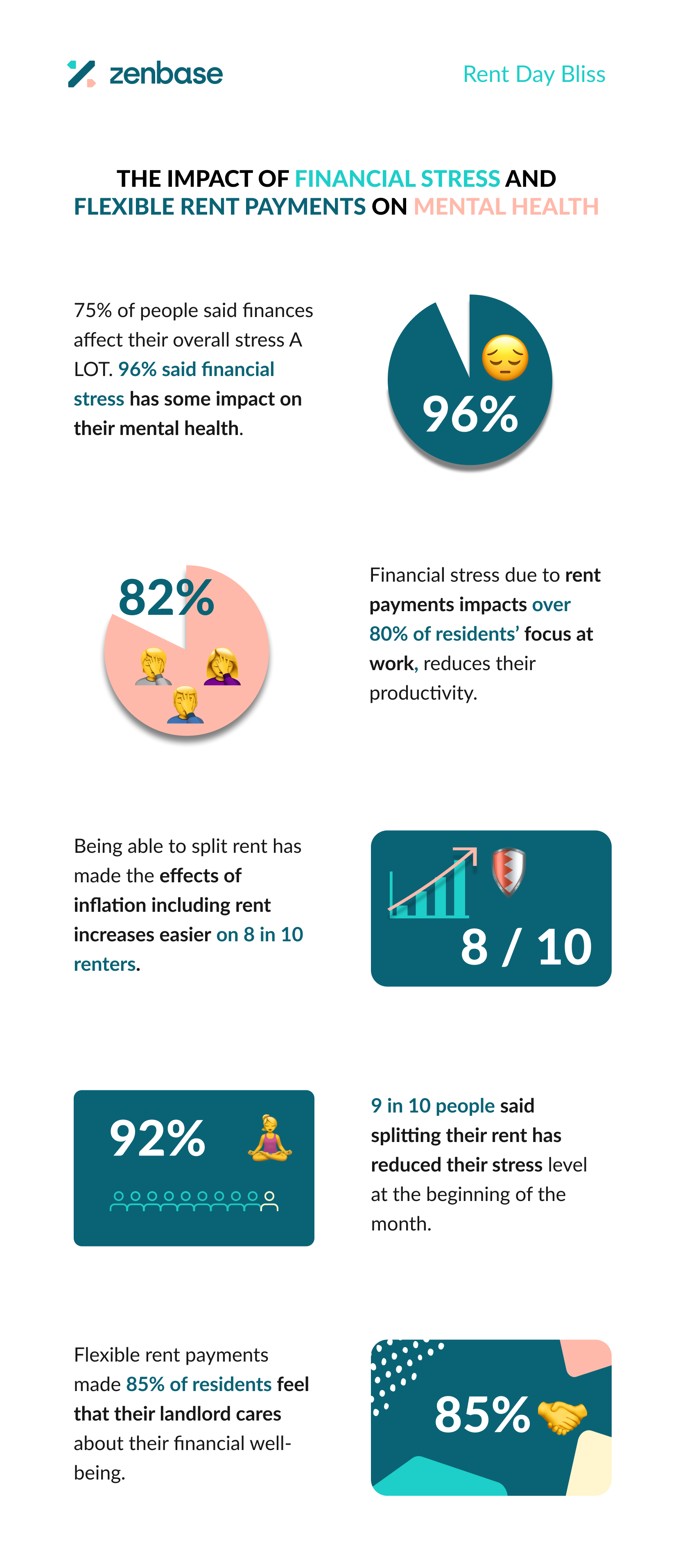
Rent is the biggest line item in a household budget, accounting for 30% or more in total expenses for millions of households. We asked Zenbase members how financial stress is impacting their overall wellbeing and how they feel about flexibility around their rent payment schedule. The results are below:
Personal finances are, well, personal. When life happens people may not feel comfortable or be embarrassed to ask for a lifeline including asking for a delay in their rent payment or asking for an advance from an employer or a friend. Flexible rent payments are designed to make it easier to budget while providing the safety net for timely rent payments and avoiding financial stress. Here’s what one of our members had to say about that:
Zenbase has literally increased my lifespan. My stress level has been reduced ten fold because I now do not have to worry about rent and payments. These guys give great service and will change your life. I promise you that!
Claude Thorimbert – Zenbase Member
Our property management partners allow us to offer flexible rent payments to their communities and deliver rent day bliss on the 1st of the month, boosting their ESG initiatives. In the current inflationary environment, all households are squeezed with rising cost of household expenses. With flexible rent payments residents have an option to split their rent payments when needed to free up cash between paychecks and avoid reliance on credit cards and other debt products.
Housing supply is at its lowest level and vacancies are at record low, 3% nationwide. When residents are spending up to 50% of their income on rent, there is a significant need to expand on the “S” (Social) in ESG with solutions that improve the financial health of rental communities.
ESG is the acronym for “Environmental, Social and Governance” that has become crucial for investment considerations globally. Multifamily developments that invest in sustainable features (Environment) and/or provide affordable housing (Social) are more likely to find options from capital sources looking to meet ESG targets. With the current housing policies, it’s extremely hard to invest in “S” by building affordable housing though luckily it is possible to help tackle affordability challenges by offering alternative solutions.
A Equifax report published last week said:
“Credit card balances rose to the highest level since the fourth quarter of 2019 and the average credit limit on new cards is over $5,800, the highest it has been in the last seven years.”
Bloomberg
To avoid racking up credit card debt, paying late fees and being stuck between paychecks households need more flexibility in paying their bills, starting with rent.
Almost 40% of the households are spending 30-50% of their income on rent leaving them with very little buffer between paychecks to manage household expenses as a whole. Such affordability issue is creating financial stress for residents from all income brackets who end up with two options: a) find a new home or b) deal with it.
Apart from the mental, social and economical challenges around changing homes, current trends make it extremely difficult to find a new home
When finding a new home is not a real option, residents can do nothing but just deal with their rent payments and affordability issues.
We, at Zenbase are not housing developers therefore cannot fix the housing supply shortage and avoid affordability issues. However we can partner with property managers, owner & operators to help residents navigate affordability issues by splitting their rent payments and giving them flexibility & control to manage their household expenses as a whole. We think it’s unfair that the biggest expense of the month needs to be paid on the 1st while it takes at least 14 days to receive all monthly earnings to cover that expense.
Flexible rent payments is an effective option in the toolkit of our partners to boost their “S” initiatives in ESG and help improve their residents’ financial health with flexible rent payments. Learn more here.
When we launched Zenbase, our first members were trying out the service simply for a rent day lifeline. These members would not always have the full rent amount in the bank until the last day of the month and end up paying late fees and overdrafts. As inflation soared we started seeing a different member profile with higher income who used Zenbase to better budget and smoothen out their cashflow throughout the month.
Before we illustrate how flexible rent payments help with budgeting for all household expenses let us share some quick stats about the Zenbase members:
In the current inflationary environment, core household expenses including rent, food and gas increased more than 10% and started squeezing all households regardless of their income. Households turned to debt to manage the additional financial burden and according to Equifax consumer debt increased by 9% since May 2021 and we are seeing a 10% increase in credit card balances.

More than 50% are living paycheck to paycheck from all income levels and now dealing with a greater gap between two paychecks. Here is an example:
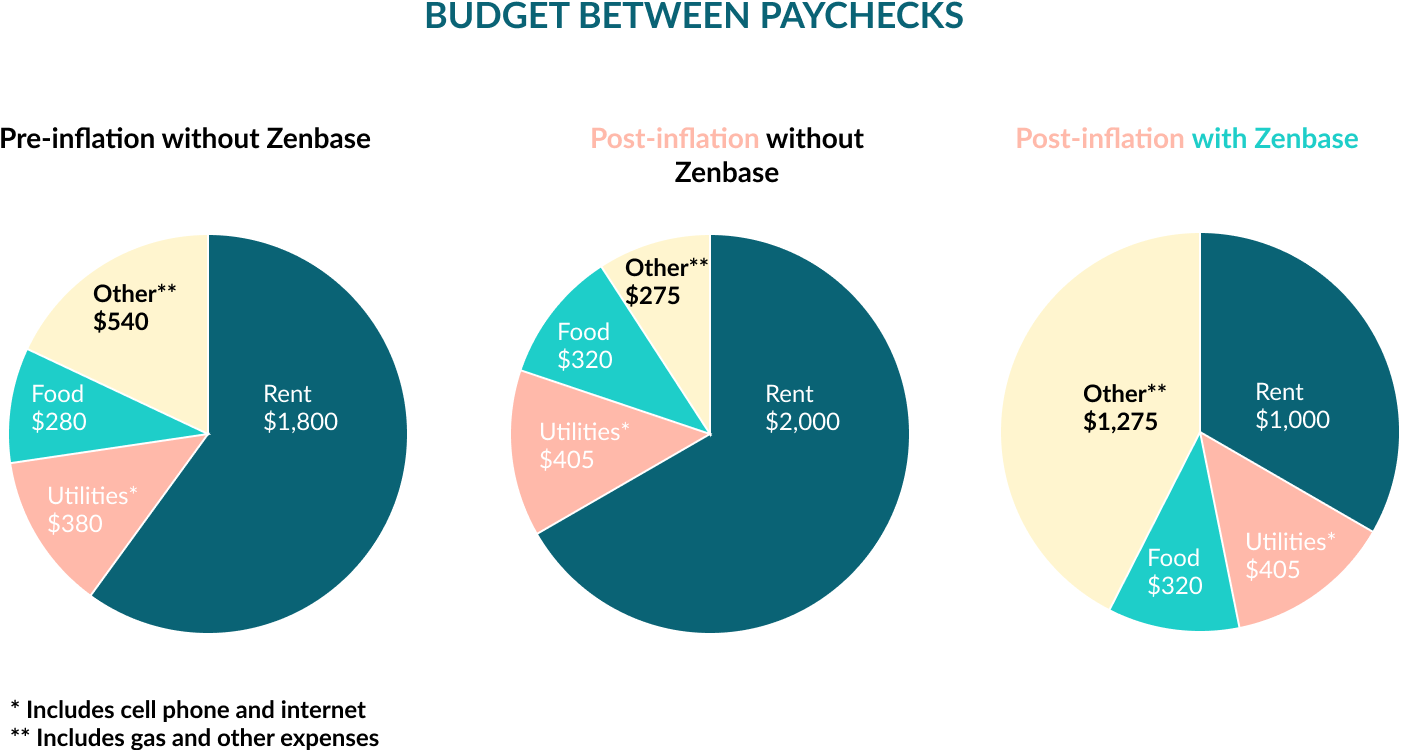
Flexible rent payments align the timing of his payments with cash availability. After splitting his rent payment Bob keeps $1,275(365% more) to cover all other expenses until he receives his next paycheck. By splitting his rent payment he smoothens out his cashflow and better aligns his cash with the timing of his household expenses.
Those with 30% ‘rent to income’ coverage ratio are assumed to be in core housing need or rent burdened: as a general rule, a healthy household budget should remain below that ratio. Unfortunately more households are now spending more than 30% of their income on rent and struggling with affordability. The risks due to rent affordability impact the rest of the household finances leaving very little room to manage other bills or any unexpected expense.
Flexible rent payments creates such room in the household budget and automates budgeting which all residents can benefit from regardless of their income level. Jordyn has been a Zenbase member for the past 6 months:
“It’s super helpful being able to split payments up, especially with everything going up in cost lately! Zenbase is easy to use, friendly. It’s a quick help, would recommend to anyone!”
Jordyn – Zenbase Member
Trent is one of the property managers responsible for more than 2,000 units:
“Being able to offer residents flexible, low/no-cost options that will make it easier for them to stay on top of their most critical living expense is valuable at any time; but in a era of inflation, and the consequent rising costs of living, it becomes ever more valuable.”
Trent – Property Manager
Flexible rent payments is the designed to free up cash between paychecks and avoid reliance on credit card and other debt products. It gives the control of their household finances to the residents and helps them do the right thing financially.
Times are changing, and the ways we pay are no exception. Consumers are demanding — and being offered — flexible payment options across the board and the property management business, an industry that’s been historically slow to embrace technology, is being left behind. Coupled with our current economic climate, this presents an opportunity.
The world today is not the same place it was even two years ago. The pandemic has changed consumer preferences and for many of us, our fortunes as well. In May 2022, the inflation rate in Canada reached a 33-year high, at 7.7 per cent while wages have only grown by roughly three percent in the past year. Coupled with a rise in interest rates, consumers are paying more for everything. With day-to-day essentials, like food, gas, and rent becoming more costly it’s no surprise people are looking for ways to make their money last the whole month.
The current environment has resulted in solutions like “buy now, pay later” or BNPL payment plans that offer greater financial flexibility for consumers. And BNPL is being applied to the housing industry to manage rents, too — a Motley Fool survey suggests over half of renters would “probably” or “definitely” pay more for flexible payment options in a rental property. This move towards flexible payments, which allows consumers to split their rent up into smaller installments throughout the month, is part of a growing demand for enhanced services, including digital rent payments, according to a report from insurance company Entrata.
Flexible Payments to Support Improved Financial Health
Flexible payment options benefit both property owners and renters. Renters have the ability to break up their rent payment into smaller installments, while property owners can maintain more reliable collections and better renter retention. The financial wellbeing index from LifeWorks, released in October 2021, suggests that almost 30 per cent of Canadians live paycheck to paycheck, and roughly 26 per cent say they can’t come up with $2,000 in an emergency if they needed to. Giving renters a flexible solution to pay their rent, even if faced with a sudden financial emergency, can help them avoid late payment fees, which can add up to $150 a month on a $1,200 rent. It also helps renters avoid the financial stress of falling behind.
Avenue Living Communities + Zenbase: A Benefit for All Residents
For Avenue Living Communities (ALC), a partnership with Zenbase is just another way to enhance the resident experience and provide exceptional customer service. ALC is focused on providing top-quality management to its residents across the Prairies, and offering a flexible payment service has been a key differentiator. For a small fee, Avenue Living Communities residents can use Zenbase to split their rent into two payments, dividing their rent to match their pay schedule. Zenbase covers the monthly rent up-front, and residents have an extended window to pay it back in full and avoid the service fee. Zenbase also offers a $100 cash advance, to provide support with groceries or other expenses on months when budgets are tight. “Splitting your rent into two payments is awesome,” writes Diane in a Zenbase Google review. “You don’t feel stranded at the end of the month.”
A Win-Win
“Rent is due on the first” is one of the last, albeit stubborn, remnants of the past, and we may be seeing the beginning of its extinction. Avenue Living Communities, in partnering with Zenbase, is offering their residents flexibility, freedom of choice, and another way to take control of their finances. We all deserve options, whether we rent or own our homes, and flexible rent payment services like Zenbase provide property managers with the technology to make those options a reality.
Learn more about Zenbase, and how we can help property managers offer exceptional customer service.
Q: Koray what’s the 20 second booth pitch and how are you different from other rent payment platforms?
A: We’re a flexible rent payment platform that eliminates late payments. Residents can pay as much as $150 for late payments and landlords can lose a good chunk of their margins because of the operational cost of managing late payments. We are fixing this by covering the residents on the first of the month and receiving their rent in smaller payments when they get paid.
Q: Ok, well, talk to us about the financial health of residents and why that’s important?
A: 25% of the renting families are in core housing need and more than 50% of the renting households are living paycheck to paycheck. These folks are vulnerable to life events: loss of employment, reduced hours, unexpected health issues. So they don’t always get to make their biggest expense, rent, during that time.
When this happens they don’t have good options to turn to:
1) predatory lenders or
2) deal with overdrafts, late fees in case of rent.
This further worsens their financial health leading to repeat late rent payments and potentially to eviction. Good people shouldn’t have to leave and we are partnering with landlords to improve the financial health of their residents.
Q: So, coming out from all the government mandates and now into high inflation our industry is being negatively affected – Koray, what late payment trends are you seeing these days?
A: As the number of families in core housing need increases, we are seeing an increase in late payments as well. Given a more risk averse credit environment, we are seeing a reduced number of options for the residents to catch up on their rent payments. Because of this we are seeing a greater operational overhead to manage late payments while straining the relationship with the residents.
Q: Alright – how much can a late payment cost a tenant?
A: Insanely high, things can really add up. With pandemic pre-authorized debit became the most common payment method. This means greater risk of bank overdraft fees that can be as high as $48. On top of that landlords can charge between $50-$100 overdrafts fees. When you add late fees on top of that one can pay as high $150 for an average of $1,200 rent.
Q: Well, now that rents are finally increasing – are you seeing any groups disproportionately affected – and how can property managers maintain on time rent payments during these transitioning times?
A: Visible minority groups are almost twice as likely to be in core housing need. To help their communities it is now more important than ever to offer flexible payment solutions that match the cashflow timing of their residents.
Q: Before we go is there anything else you’d like to mention?
A: Financially healthier residents create happier and healthier communities. So housing affordability issue is a healthcare issue as well: low-income unstable household is 2X more likely to be in fair or poor health than those in stable housing, and almost 3X more likely to report depressive symptoms. I think we are all responsible for taking care of our communities.